
CE marking
CE certified boat: the documents and markings that come with it
There is no single "CE certificate" for a boat. What the declaration of conformity, builder's plate, identification number and owner's manual are, and who issues them.
People ask for a boat’s “CE certificate”, but no single document has that name. A CE marked recreational craft comes with a set: on the boat, a builder’s plate that carries the CE marking and a separate watercraft identification number; with the boat, an EU declaration of conformity and an owner’s manual. Behind them are the manufacturer’s technical documentation and, on some routes, a certificate issued by a notified body.
This article explains what each one is, who issues it and what to check when you buy or build a boat. The legal basis is Directive 2013/53/EU (the Recreational Craft Directive); Türkiye applies the same rules through its own regulation, so a boat built in Türkiye for the EU market carries the same set.
At a glance: which document is where?
| What | Where you find it | Who issues it | Basis in Directive 2013/53/EU |
|---|---|---|---|
| CE marking | On the builder’s plate | The manufacturer (or the person who has a post-construction assessment carried out) | Articles 17–18 |
| Builder’s plate | Permanently fixed to the boat | The manufacturer | Annex I, Part A, point 2.2 |
| Watercraft identification number | On the boat, apart from the plate | The manufacturer | Annex I, Part A, point 2.1 |
| EU declaration of conformity | A document handed over with the boat | The manufacturer, the private importer or the person who has a post-construction assessment carried out | Article 15, Annex IV |
| Owner’s manual | With the boat | The manufacturer | Article 7(7), Annex I, Part A, point 2.5 |
| Technical documentation | With the manufacturer (not given to the buyer) | The manufacturer | Article 25, Annex IX |
| Notified body certificate | With the manufacturer; referred to in the declaration | The notified body, where one was involved | Article 18(3), Annex IV point 7 |
Where is the CE marking on a boat?
On a watercraft the CE marking is affixed on the builder’s plate, and the plate is mounted separately from the identification number (Article 18(1)). The marking must be visible, legible and indelible, and it is affixed before the boat is placed on the market or put into service.
A four-digit number next to the CE marking is the identification number of a notified body: it follows the marking where that body was involved in the production control phase or in a post-construction assessment (Article 18(3)). A plate without such a number is not, in itself, a defect: for some craft the manufacturer may follow a route that does not involve a notified body. Which routes are open depends on the design category and the hull length (Article 20).
What does the builder’s plate say?
The plate is permanently affixed and contains at least (Annex I, Part A, point 2.2):
- the manufacturer’s name, registered trade name or trade mark, and contact address,
- the CE marking,
- the design category of the craft (A, B, C or D),
- the manufacturer’s maximum recommended load,
- the number of persons recommended by the manufacturer for which the craft was designed.
After a post-construction assessment the plate also carries the details of the notified body that carried it out.
To lay out the data for a plate of your own, you can use the Builder’s Plate Generator; it produces a draft and does not decide on conformity.
What is the identification number?
Every craft is marked, apart from the plate, with an identification number. You may know it as the CIN or, from North America, the HIN; the Directive calls it the watercraft identification number. It includes (Annex I, Part A, point 2.1): the country code of the manufacturer, the manufacturer’s code assigned by the national authority, a serial number, the month and year of production, and the model year. Its exact format is set out in the relevant harmonised standard.
For a buyer the practical point is consistency: the plate and the declaration should describe the same boat as the number on the hull.
The EU declaration of conformity: what people usually mean by “CE certificate”
The document a buyer receives is the EU declaration of conformity. It states that the fulfilment of the Directive’s requirements has been demonstrated, and by drawing it up the issuer assumes responsibility for the compliance of the product (Article 15(1) and (3)). It accompanies the boat when it is made available on the market or put into service (Article 15(4)).
It is not issued by an authority or by a notified body. The manufacturer draws it up; where the manufacturer has not taken that responsibility, the private importer or the person who has a post-construction assessment carried out does (Article 15(3); Annex V, point 4.2).
The Directive gives a model structure (Annex IV). A declaration that follows it contains:
- the identification of the product (product, batch, type or serial number),
- the name and address of the manufacturer or the authorised representative, or of the private importer,
- the statement that the declaration is issued under that person’s sole responsibility,
- the object of the declaration: a description that allows the craft to be traced (it may include a photograph),
- the statement that the object is in conformity with the relevant Union legislation,
- references to the harmonised standards used, or to the other technical specifications in relation to which conformity is declared,
- where applicable, the notified body’s name and number, what it did and the certificate it issued,
- the person empowered to sign; place and date of issue, name, function, signature.
Giving the declaration a number is optional. For engines, point 9 asks for additional statements; they are outside this article.
The declaration is translated into the language or languages required by the Member State where the boat is made available or put into service (Article 15(2)).
Illustration: a blank EU declaration of conformity
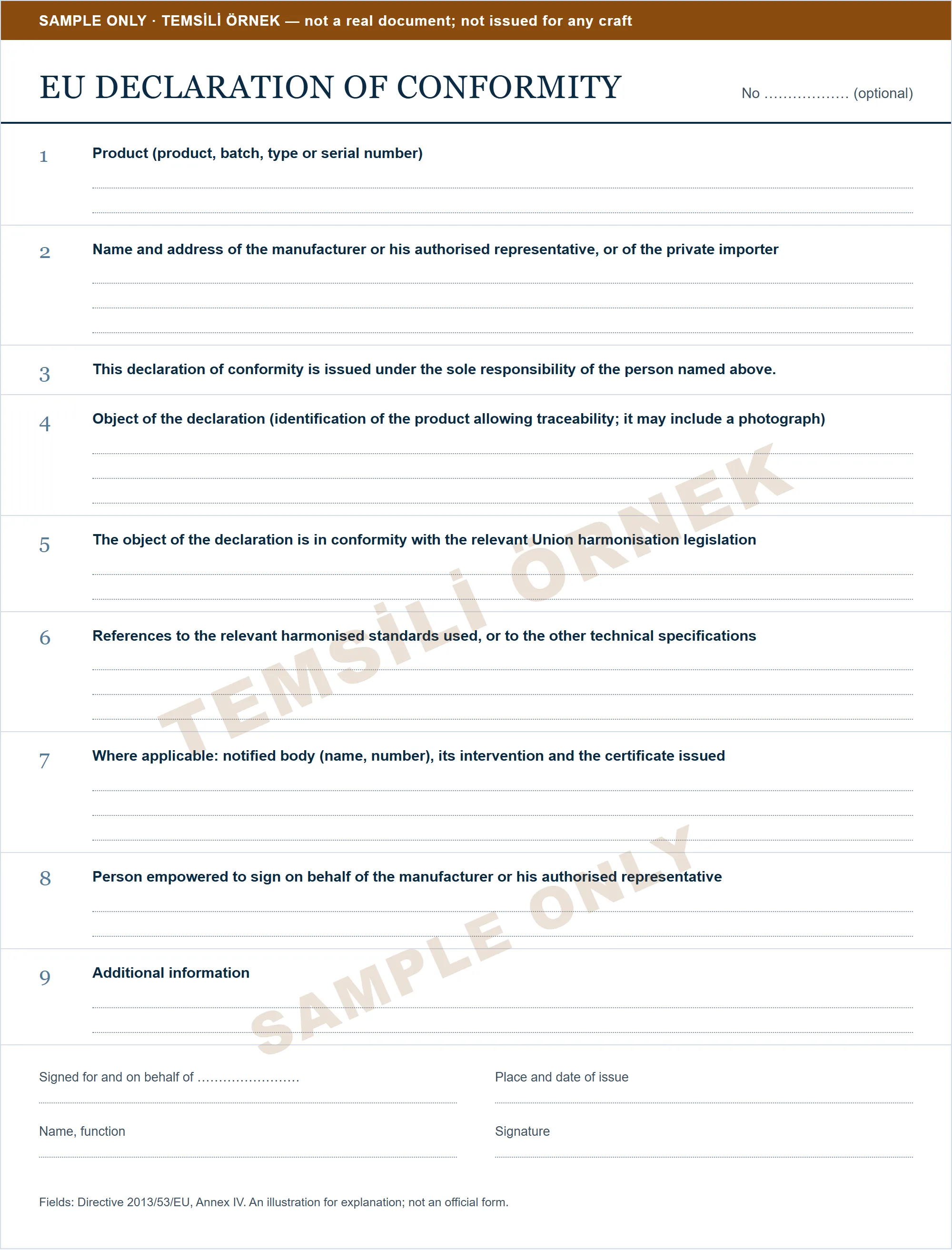
This drawing only shows the order of the fields: it is not an official form, was not issued for any craft and cannot be filled in and used. The layout of a real declaration varies from one manufacturer to another; what matters is that the elements above are there and agree with your boat. Another boat’s declaration proves nothing about yours.
The owner’s manual
Each craft is provided with an owner’s manual. It gives the information needed for safe use, with particular attention to set-up, maintenance, regular operation, prevention of risks and risk management (Annex I, Part A, point 2.5). The manufacturer makes sure the instructions and safety information are in a language easily understood by consumers, as determined by the Member State concerned (Article 7(7)).
Technical documentation: why the buyer does not get it
The technical documentation is everything the manufacturer used to make sure the craft meets the requirements: a general description of the type, design and manufacturing drawings, the list of standards applied, design calculations, test reports or calculations on stability and buoyancy and, where relevant, exhaust and sound emission test reports (Article 25, Annex IX).
The manufacturer keeps the technical documentation and a copy of the declaration for 10 years after the product has been placed on the market (Article 7(3)) and provides them to a national authority on a reasoned request. It is not handed to the buyer; the buyer’s counterpart is the declaration of conformity.
When is there a notified body certificate?
Where a notified body took part, it issues a certificate for what it did, and point 7 of the declaration names the body, its intervention and the certificate (Annex IV). On a route with an EU type-examination, for example, there is an EU-type examination certificate (Article 24(1)); in a post-construction assessment the body issues a certificate and a related report of conformity (Annex V, point 3).
That certificate does not replace the declaration. It records the body’s own assessment; the document that carries responsibility for the craft’s conformity is the declaration, signed by the manufacturer (or by the person who follows the post-construction route). Whether a body is notified for this Directive can be checked in the European Commission’s NANDO database.
When there is no manufacturer’s declaration: post-construction assessment
Where the manufacturer has not taken responsibility for the craft’s conformity, the documents come from a post-construction assessment. The Directive provides for it in three situations (Article 19(2) to (4)):
- Private import. A private importer applies it before putting the product into service, if the manufacturer has not carried out the conformity assessment.
- Major modification or change of purpose. Any person placing on the market or putting into service a propulsion engine or a watercraft after a major modification or conversion, and any person who changes the intended purpose of a watercraft not covered by the Directive so that it falls within its scope.
- A boat built for own use. Any person placing such a watercraft on the market before the end of the five-year period.
On this route the person applies to a notified body; the body examines the individual product, issues a certificate and a related report of conformity and has its identification number affixed next to the CE marking. The person placing the product on the market or putting it into service affixes the CE marking, draws up the EU declaration of conformity and keeps the documents for 10 years (Article 23, Annex V). A private importer also makes sure that the name and address of the notified body are marked on the product (Article 12(3)).
Whether this concerns a second-hand boat depends on whether it falls into one of these three situations: a craft that was placed on the market with its manufacturer’s declaration and still has its documents does not need a new assessment merely because it changes hands. For a boat without documents, or one in any of the situations above, the applicable route is looked at case by case.
More about the process: support for post-construction assessment (PCA).
A buyer’s checklist
- Is there a permanently fixed builder’s plate with the CE marking, the design category, the maximum load and the number of persons?
- Is there an identification number on the boat, apart from the plate?
- Does an EU declaration of conformity come with the boat, signed and dated?
- Do the description and the number in the declaration match the boat in front of you?
- If the declaration names a notified body, does its number match the one next to the CE marking on the plate?
- Is there an owner’s manual?
The list helps you check that the documents exist and agree with each other. It is not an assessment of whether the craft meets the requirements.
Frequently asked
Who issues a boat’s CE certificate? No single authority does. The manufacturer draws up the EU declaration of conformity and takes responsibility for it. On some routes a notified body carries out an assessment and issues its own certificate; the CE marking is still affixed by the manufacturer (or by the person who has a post-construction assessment carried out).
The boat has a CE marking but no declaration of conformity. Is that normal? Under the Directive the declaration accompanies the craft (Article 15(4)). If it is missing, ask the seller or the manufacturer first; the manufacturer has to keep a copy for 10 years.
Is the declaration of conformity the same as a notified body certificate? No. The declaration is signed by the manufacturer and carries the responsibility for conformity. The certificate records the notified body’s assessment and exists only on the routes in which a body is involved.
Does a boat built in Türkiye come with the same documents? For a craft placed on the EU market the Directive’s requirements are the same wherever it was built. Türkiye’s own regulation (Official Gazette No. 30057) contains the same elements in its Articles 16 to 19 and 26 and its Annexes 1, 4 and 9: the EU declaration of conformity, the CE marking on the builder’s plate, the identification number, the owner’s manual and the technical documentation. How documents drawn up in Türkiye are treated in a given EU Member State is a separate question that this article does not cover.
Does TEKNECE issue CE certificates? No. TEKNECE is not a notified body and does not draw up declarations of conformity. It supports builders and owners in preparing the technical documentation, choosing the applicable route and working with the notified body: CE compliance support.