
Design categories
Boat CE categories A, B, C and D: what each rating means
CE categories A, B, C and D are wind and wave limits a boat is designed for: what each rating allows, what it does not, and how it compares with a forecast.
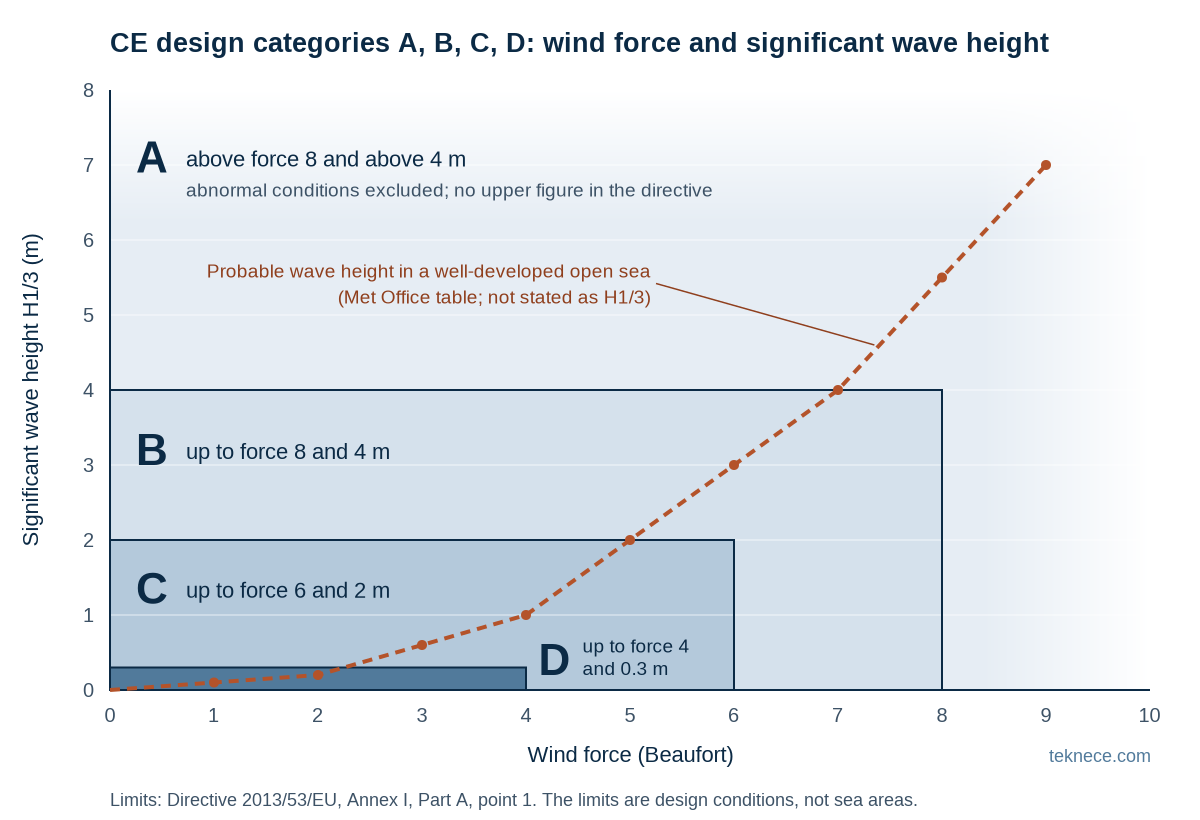
A boat’s CE category, officially its watercraft design category, states the wind force and the significant wave height it was designed for. Category A is above Beaufort force 8 and above 4 m, with abnormal conditions excluded. Category B is up to force 8 and 4 m. Category C is up to force 6 and 2 m. Category D is up to force 4 and 0.3 m. The limits come from Directive 2013/53/EU (the Recreational Craft Directive), Annex I, Part A, point 1.
The letter is one of the most quoted and most misread items on a builder’s plate. It is not a list of seas you may sail in, not a quality grade, and not a promise about a particular day. This guide gives the exact legal limits, compares them with what a marine forecast tells you, and explains who assigns the category.
CE category chart: A, B, C and D compared
| Category | Wind force (Beaufort) | Significant wave height (H1/3) | What the directive’s explanatory note adds |
|---|---|---|---|
| A | Exceeding 8 | Exceeding 4 m | Abnormal conditions are excluded, such as storm, violent storm, hurricane, tornado, extreme sea conditions or rogue waves |
| B | Up to and including 8 | Up to and including 4 m | No further condition |
| C | Up to and including 6 | Up to and including 2 m | No further condition |
| D | Up to and including 4 | Up to and including 0.3 m | Occasional waves of 0.5 m maximum height |
The United Kingdom uses the same table in Schedule 1 to the Recreational Craft Regulations 2017, and Türkiye uses it in Annex 1 to its own regulation (Official Gazette No 30057). The notes for A and B speak of “recreational craft”; those for C and D speak of “watercraft”, a term that also covers personal watercraft (Article 3).
What does CE category A mean?
A category A boat is designed for winds that may exceed force 8 and significant wave heights of 4 m and above. The directive sets no upper figure; it excludes abnormal conditions instead. According to the Commission’s 2022 report on the design categories, that wording implicitly keeps force 10 and an 8 m significant wave height outside category A, while the harmonised standards state explicit upper limits (COM(2022) 358, section 5.1). So “unlimited” is the wrong word: no category covers a storm of force 10 or a hurricane.
What does CE category B mean?
A category B boat is designed for up to and including force 8 and 4 m significant wave height. Force 8 is a gale: a mean wind of 34 to 40 knots. In open water with a long fetch the wave limit may be met first, as the next section shows.
What does CE category C mean?
A category C boat is designed for up to and including force 6, a mean wind of 22 to 27 knots, and 2 m significant wave height. Both numbers count together: a force 4 day with a 2.5 m swell left over from another weather system is outside the category on wave height alone.
What does CE category D mean?
A category D boat is designed for up to and including force 4 and 0.3 m significant wave height, with occasional waves of 0.5 m at most. The Commission’s guide explains the allowance: passing vessels or other local disturbances can make such waves (page 96).
Why the wave limit can come before the wind limit
The Commission’s guide treats significant wave height as the primary factor, with wind describing when such waves may be expected (page 96). The Beaufort table published by the Met Office shows why this matters. Its “probable wave heights” refer to well-developed wind waves of the open sea. The table does not state them as H1/3 values, so read the comparison as an indication.
| Category | Wave limit (H1/3) | Wind limit | Probable open-sea wave at the wind limit | Force at which the open-sea table reaches the wave limit |
|---|---|---|---|---|
| D | 0.3 m | Force 4 | 1.0 m | Between forces 2 and 3 |
| C | 2 m | Force 6 | 3.0 m | Force 5 |
| B | 4 m | Force 8 | 5.5 m | Force 7 |
In open water with a long fetch, and enough time for the sea to build, the wave limit can be reached one force or more below the wind limit. In a bay with an offshore wind it can be the other way round: plenty of wind, little sea. The Commission’s report makes a similar point for category B: for a 4 m significant wave height the World Meteorological Organization’s methodology would point to force 7 rather than 8. It still considers the current division in line with WMO knowledge (section 5.1).
How do I compare the category with a marine forecast?
Three terms cause most of the confusion.
- Significant wave height is not the highest wave. It is the average of the highest third of the waves. The Commission’s report says the maximum can be up to double the significant height (section 5.2), and NOAA gives the same approximate factor. In a 2 m sea, a single wave of about 4 m is possible; in a 4 m sea, about 8 m. The category limit itself refers to the significant height.
- Beaufort force is a mean wind, not a gust. According to the same report, gusts may be up to 40% stronger. A steady 27 knots, the top of force 6, can come with gusts of about 38 knots; 40 knots, the top of force 8, with gusts of about 56.
- Steep water is not in the numbers. The guide excludes abnormal factors such as a sudden change in depth or tidal races from the conditions behind the categories (page 96). A bar entrance or wind against tide can be dangerous at a wave height well inside the limit.
Is category A “ocean” and category C “coastal”?
Not any more. The 1994 directive named the categories Ocean, Offshore, Inshore and Sheltered waters. Directive 2013/53/EU dropped the names: recital 33 says the titles should be based only on wind force and significant wave height. The guide adds that the categories do not describe typical areas and “should not be used to limit the geographical areas of operation” (page 96).
The old names survive in brochures and listings. They are sales shorthand, not current law.
For a used boat, the number behind the letter D also needs care. The 1994 text set 0.5 m significant wave height for category D; Directive 2003/44/EC lowered it to 0.3 m with occasional waves of 0.5 m. An old D plate therefore does not always mean 0.3 m.
Can a category B boat cross an ocean?
The directive contains no navigation rules, and the guide confirms there is no link between the design categories and any such rules (page 96). The category tells you what the boat was designed for. It neither authorises nor forbids a passage.
Other rules may still bring the letter into play. Member States may adopt justified and proportionate navigation rules for certain waters, to protect the environment, the fabric of the waterways or their safety, without requiring changes to a conforming boat (Article 5). Flag-state requirements, an insurance policy, a charter licence or the rules of a rally may refer to the category, so check those documents before you plan. Then compare the limits with the conditions you could actually meet on the route and in that season.
Who decides a boat’s CE category?
The manufacturer does. No authority awards the letter. The manufacturer designs for a category and has to show that the boat meets the essential requirements tied to it, among them:
- Structure strong enough in all respects (Annex I, Part A, 3.1)
- Stability and freeboard (3.2) and buoyancy and flotation (3.3); a boat under 6 m that is susceptible to swamping when used in its category also needs means of flotation in the swamped condition
- The maximum recommended load itself (3.6)
- Life raft stowage: required in categories A and B, and in C and D for craft longer than 6 m (3.7)
- Anchoring, mooring and towing points suited to the category (3.9)
- Good handling characteristics (last paragraph of point 1)
In a post-construction assessment, the person who places the boat on the market or puts it into service takes that responsibility, and a notified body assesses the boat (Article 23, Annex V).
For stability and buoyancy, the standards cited in the EU list are EN ISO 12217-1, -2 and -3 in their 2017 editions (Implementing Decision (EU) 2022/1954, consolidated 13 March 2026). Newer editions give no presumption of conformity until they are cited there.
There is no single minimum length for category A or B. The directive applies from 2.5 m to 24 m hull length and sets performance requirements, so a small boat can be category A if it meets them, although short boats rarely do in practice, and a large one can be category C.
How the category changes the conformity assessment route
The letter and the hull length together decide which modules the builder may use for design and construction (Article 20(1)):
| Category | Hull length 2.5 m to under 12 m | Hull length 12 m to 24 m |
|---|---|---|
| A and B | A1, B + (C, D, E or F), G, H | B + (C, D, E or F), G, H |
| C | A (only if the harmonised standards for 3.2 and 3.3 are complied with), A1, B + (C, D, E or F), G, H | B + (C, D, E or F), G, H |
| D | A, A1, B + (C, D, E or F), G, H | A, A1, B + (C, D, E or F), G, H |
Under Module A the manufacturer works without third-party intervention; the other routes involve a notified body, in A1 as well, because Article 24(3) rules out in-house bodies. The table is for recreational craft; personal watercraft follow Article 20(2). Exhaust and noise emissions have their own rules (Articles 21 and 22). You can map your own case with the CE Preliminary Check, which gives an orientation and never determines a category.
Can one boat have two categories?
Yes. The guide says a watercraft can be assigned more than one category at the same time, each with its own maximum number of persons, engine power and weight, if it satisfies all relevant requirements for each. A boat might be, for example, category B with 6 people and category C with 10. The categories and their figures should then appear clearly and consistently on the builder’s plate, in the owner’s manual and on the relevant certificates (page 96).
When you read such a plate, read the pair: the category and the number of people beside it. Loading the boat to the category C figure and relying on category B is outside what was declared.
Where do I find the category, and what should a buyer check?
The category is on the builder’s plate, together with the maximum load and the number of persons (Annex I, Part A, 2.2). Before you pay for a boat, check that:
- the category on the plate matches the owner’s manual and any certificate;
- the number of persons and load belong to that category;
- nothing heavy or high has been added since, such as a hardtop, a flybridge, a crane or larger batteries, because the category was assessed with a stated weight and layout, and such a change may itself be a major craft conversion (the guide gives a flybridge as an example, page 19);
- the boat’s length in the advertisement is not mistaken for the hull length used in the rules.
What else should come with the boat is described in What does a CE certified boat come with?, and the number that ties the papers to the hull in HIN, CIN, WIN.
Will the categories change?
Not on present evidence. The Commission’s 2022 report examined subdividing C and D and redrawing the ranges, and concluded that the current division is appropriate and that changing it would not improve safety. It left open stating an upper limit for category A and explaining the weather terms in a future revision (section 7.3). On 24 November 2026 the EU register showed no published act amending the directive. A pending proposal, COM(2025) 503, would amend it on digital information and common specifications; it is not law.
Frequently asked questions
Is a category A boat safer or better built than a category C boat? It was designed for harsher conditions. The category is not a grade of finish, comfort or overall quality, and a well-kept category C boat used within its limits is being used as designed.
Which category do I need for the Mediterranean or the Aegean? The law does not assign seas to categories. Look at the forecast wind and significant wave height, allow for gusts and the largest single waves, and stay within the limits of the category on your plate.
What is the smallest category A yacht? The directive sets no minimum length for category A beyond its own lower limit of 2.5 m. What counts is whether the boat meets the requirements for that category.
Can I upgrade my boat from category B to A? Not by changing the plate. The category has to be demonstrated again. Guidance from the notified bodies’ group (RSG, ERFU 137) treats a change of the declared category as a major craft conversion, which normally points to post-construction assessment. The position differs for craft first placed on the market before 16 June 1998, and may differ when the original manufacturer makes the change. Take advice on your own case first.
Is CE category the same as “CE certified”? No. The CE marking shows that the boat was declared to conform to the directive. The category says for which wind and waves it was designed. Both are on the builder’s plate.
Does TEKNECE assign design categories? No. The manufacturer assigns the category, and a notified body examines it where the chosen module, or a post-construction assessment, requires one. TEKNECE helps builders prepare the technical documentation through CE process support and checks condition and paperwork for buyers through a marine survey.
This article is general information. Each craft is assessed on its own documents, calculations and tests. The Commission’s guide and the RSG guidance explain the directive but are not binding law. Official texts: Directive 2013/53/EU, the RCD Application Guide and the list of harmonised standards.